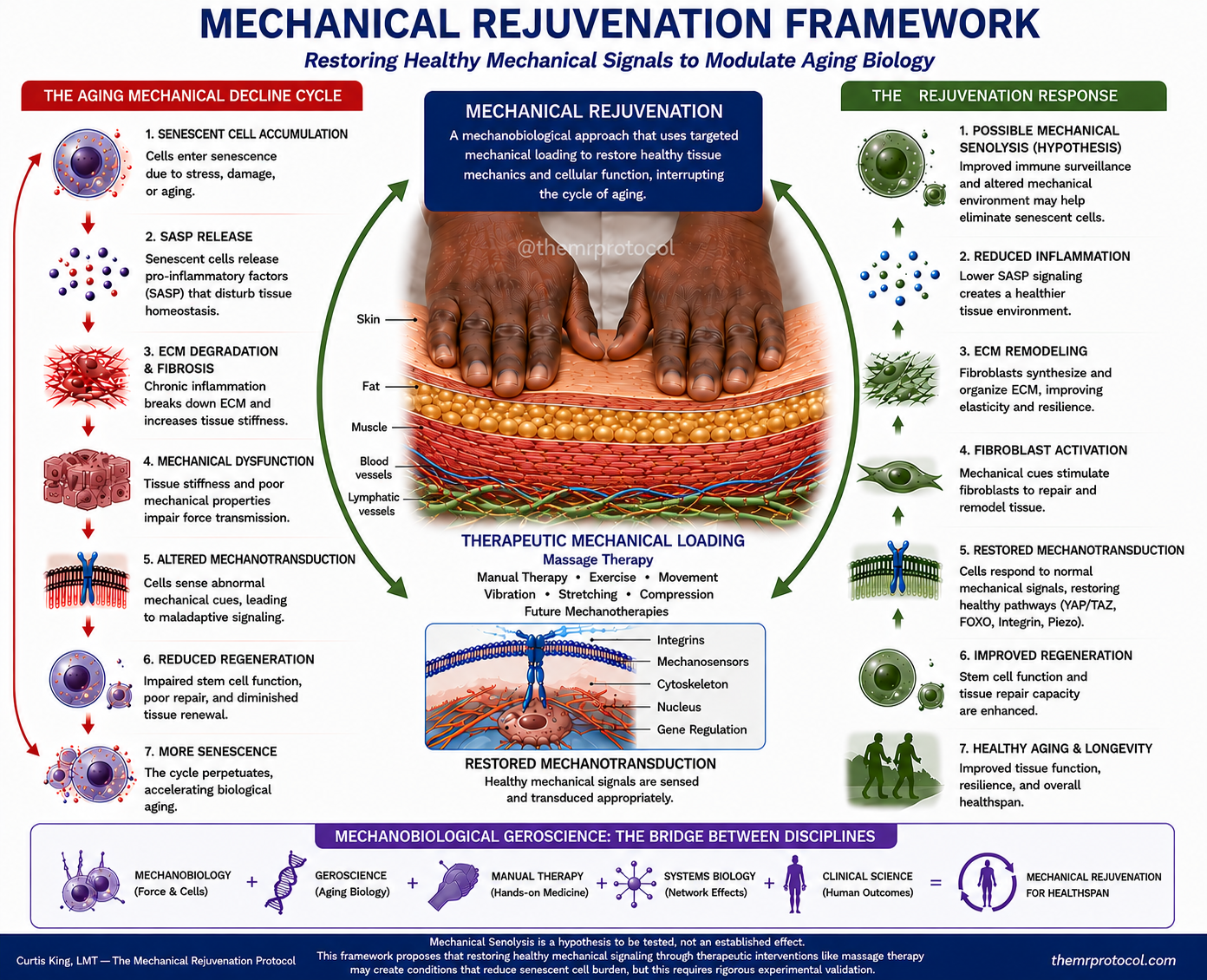
As we age, the extracellular matrix stiffens. Collagen cross-links accumulate. Fascial layers adhere. Lymphatic flow slows. Senescent cells settle into tissue and secrete the inflammatory cocktail known as the SASP — a mixture that degrades matrix proteins, spreads inflammation, and suppresses the very stem cells responsible for repair.
These changes are not molecular abstractions. They are physical realities you can feel in your body: reduced range of motion, stiffness on waking, tissue that no longer bounces back, swelling that lingers, injuries that heal more slowly than they used to.
Longevity medicine has no answer for this dimension. Not because it doesn't matter — but because the field has not yet organized itself around the problem. There is no name for it. No framework. No protocol.
The connective tissue does not exist independently of the cell. It speaks to the cell constantly, through a process called mechanotransduction — the conversion of physical force into biochemical signal. Integrins, focal adhesions, the cytoskeleton, and the YAP/TAZ pathway translate mechanical load into gene expression. Your fibroblasts listen to the matrix around them and decide, based on what they hear, whether to build, repair, or fall silent.
When mechanical input is absent or dysregulated, the signaling collapses. Fibroblasts become quiescent. Matrix turnover slows. Senescent cells accumulate. Inflammation compounds. The tissue ages faster than the calendar demands.
The pathways engaged by therapeutic mechanical stimulation — integrin-FAK, RhoA/ROCK, NF-kB, Hippo/YAP — are the same pathways dysregulated in cellular senescence. This is not coincidence. It is the biology of the physical dimension of aging.