2023
Journal of Orthopaedic Research
Tensile loading parameters and collagen alignment in human Achilles tendinopathy
Defines the strain window most effective for tendon matrix realignment.
Massage therapy engages multiple biological pathways central to cellular senescence. Here is what the science says — and what it does not yet say.
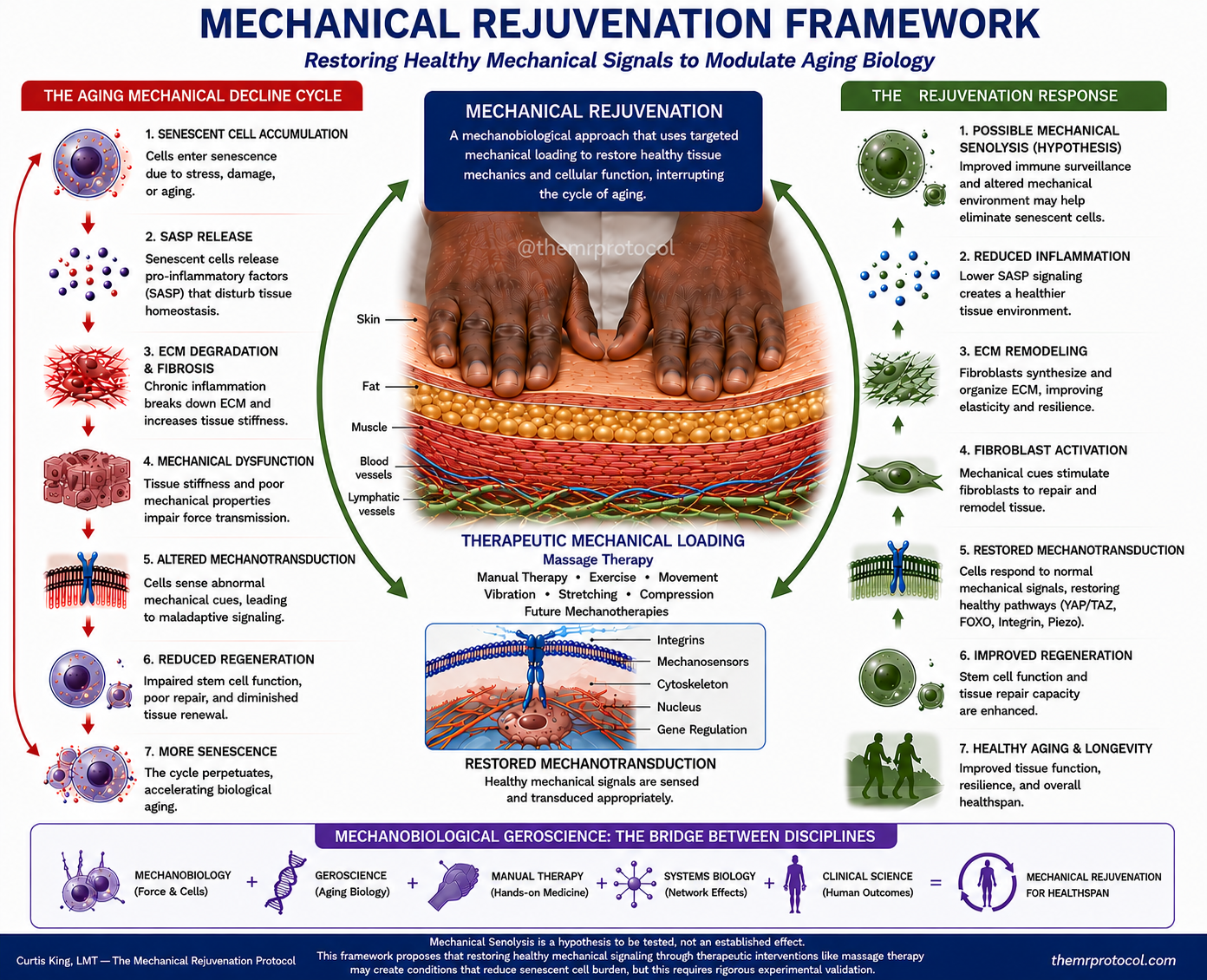
Your body accumulates damaged cells with age. These cells — called senescent cells — stop dividing but refuse to die. Instead they secrete a toxic mixture of inflammatory proteins called the SASP: the senescence-associated secretory phenotype. The SASP includes IL-6, TNF-alpha, and matrix metalloproteinases — compounds that dissolve your connective tissue, spread inflammation to neighboring healthy cells, suppress the stem cells responsible for tissue repair, and sustain the chronic low-grade inflammatory environment that underlies virtually every age-related disease.
This is inflammaging. And it has a physical dimension that is as important as its molecular one. As senescent cells accumulate and the SASP degrades your extracellular matrix, your tissue undergoes measurable physical changes: stiffening, fibrosis, fascial adhesion formation, lymphatic dysfunction. No senolytic drug addresses this physical dimension. That is the gap The Mechanical Rejuvenation Protocol exists to fill.
Mechanical Rejuvenation is defined as the restoration of youthful tissue behavior through targeted mechanical stimulation that optimizes mechanotransduction signaling, extracellular matrix organization, inflammatory regulation, and regenerative cellular activity.
It works through a biological process called mechanotransduction — the conversion of physical force into biochemical signals. The signaling pathways activated by therapeutic mechanical stimulation — integrin-FAK, RhoA/ROCK, NF-kB, Hippo/YAP — are the same pathways dysregulated in senescent cells and aging tissue.
A landmark study published in Science Translational Medicine demonstrated that therapeutic massage reduces intramuscular IL-6 and attenuates NF-kB activity at the molecular level in human subjects. A 2025 systematic review documented consistent reduction in IL-6 and TNF-alpha through manual therapy across multiple inflammatory populations.
No study has yet directly measured senescent cell burden before and after a massage protocol. That study needs to happen. The Mechanical Rejuvenation Protocol is building the clinical infrastructure and outcome dataset to support that research.
What the evidence does establish is that massage therapy engages multiple pathways known to influence senescence biology. We also propose a specific testable sub-hypothesis called Mechanical Senolysis: that because senescent cells possess mechanically distinct phenotypes, appropriately calibrated manual therapy may ultimately facilitate their selective elimination or immune-mediated clearance.
The Mechanical Rejuvenation Protocol is built on what the science currently supports. It is designed to generate the data that advances what science will support next.
Before the paper there was the manifesto. The intellectual and philosophical foundation of The Mechanical Rejuvenation Protocol — written before the first client, before the first session, before the first line of the position paper. Read it to understand not just what we are building but why.

Licensed Massage Therapist — 18 years clinical experience
Certificate in Stretch and Flexibility Coaching
Independent researcher in mechanobiology and geroscience
Founder, The Mechanical Rejuvenation Protocol — Central Florida
Defines the strain window most effective for tendon matrix realignment.
Comprehensive review of chondrocyte response to physiological loading.
Foundation for the bone-loading frequency curve used in the protocol.
Molecular basis for the input → signal → adaptation chain.
Direct evidence for the periodization scheme used in MR Protocol block 2.
Studies are included only when (1) the mechanical input is fully characterized, (2) outcomes are measured with imaging, histology, or validated functional tests, and (3) the intervention is reproducible in a clinical or training setting.